The Strategy Isn’t What Makes the Math Conceptual
The goal isn’t for students to become really good at following our favorite strategy. The goal is for them to understand numbers well enough to make strategic choices for themselves. N-U-M-B-E-R S-E-N-S-E.
For 8 + 5, making a ten might make sense. For 7 + 7, a student might recognize a double. For 5 + 7 + 6, one student might see 5 + 7 as 12 and then add 6, while another might combine 7 + 6 because they know 6 + 6 and can adjust. Someone else may notice a completely different relationship.
That’s where the mathematics is.
As mathematics educators, we shouldn’t just accept multiple strategies. We should encourage them.
Students need repeated opportunities to explore numbers, notice relationships, make connections, and choose strategies that make sense to them. That’s how they develop number sense and build mathematical understanding that belongs to them.
If we want students to develop their own strategies, we have to give them something to think with. We can’t show them three strategies on Monday, have them practice each one on Tuesday, and call that conceptual understanding.
Students need opportunities to play with numbers. To compose and decompose them. To notice relationships. To represent their thinking in different ways. To hear how another student saw the same problem. To try a strategy, change their mind, and try something else.
And perhaps most importantly, we have to resist doing the noticing for them.
That’s one of the ideas that shaped Progressions by Alba Math. We didn’t want to create a curriculum that simply replaced one set of procedures with a new set of “conceptual” procedures. We wanted to create experiences that help children develop the number sense they need to make sense of mathematics for themselves.
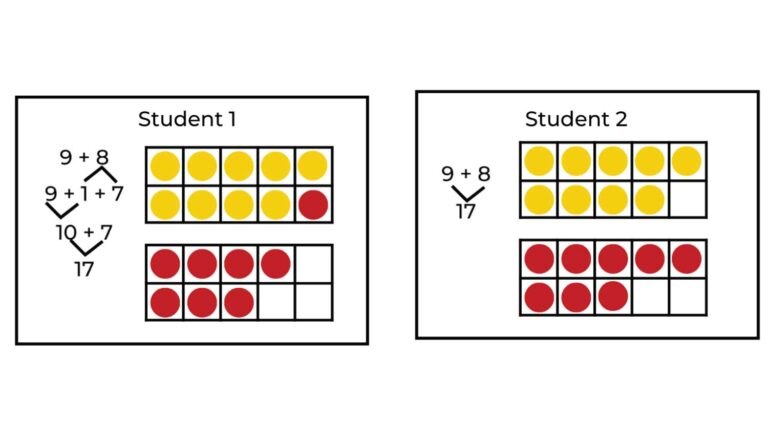
Here is an example from a first grade Progressions lesson. After revisiting Pete the Cat and the Missing Cupcakes, students use double ten frames and counters to solve cupcake problems. Rather than being given a strategy to follow, students build a model, solve the problem, and share their thinking.
For 9 + 8, two students might represent their thinking very differently.
One student decomposes 8 and makes a ten. Another represents each addend on a separate ten frame and may count on or count all to determine the sum. Neither student is told which strategy to use. Instead, the teacher asks students to compare the models by asking, “Where do you see the eight in each model?” or “Which model helps determine the sum faster? Why?” That last question matters.
We could tell students that making a ten is more efficient. We could model the steps, give them ten problems to practice, and they might become very good at doing exactly what we showed them.
But then we did the noticing.
When students compare the models, they have the opportunity to notice why making a ten can be useful. Now making a ten isn’t just a strategy they were taught. It’s a relationship they understand.
Giving students freedom to choose strategies doesn’t mean we simply put manipulatives on the table and hope mathematical understanding happens. Conceptual instruction requires incredibly intentional teaching. The teacher listens for student thinking, selects representations worth discussing, asks questions that make relationships visible, and helps students connect one idea to another.
Sometimes that means allowing a student to use a less efficient strategy because it makes sense to them. Other times, it means asking a question that helps them notice a more efficient one. Efficiency becomes something students learn to recognize, not simply something the teacher defines for them.
The goal isn’t to choose the strategy for the student. It’s to build the understanding that allows the student to choose for themselves.
A number bond doesn’t make a lesson conceptual. Neither does a ten frame, a number line, a manipulative, or a make-a-ten strategy on a double ten frame. They’re tools. What makes the mathematics conceptual is what students are doing with those tools. Are they noticing relationships? Making connections? Explaining their thinking? Comparing approaches? Making decisions based on what they understand about numbers? If we’re not careful, we can take every beautiful tool designed to help children make sense of mathematics and turn it into another set of steps to memorize.
The goal isn’t to teach students more strategies. The goal is to develop mathematicians who understand numbers well enough to develop their own strategies.
Conceptual math focuses on helping students understand mathematical relationships and why strategies work, rather than simply memorizing steps or procedures.
Why is number sense important in early mathematics?
Strong number sense helps students recognize relationships between numbers, make strategic choices, and reason flexibly about mathematics. Building these foundations early prepares students to make sense of increasingly complex mathematics as they grow.
Is “making ten” a conceptual math strategy?
Making ten can support conceptual understanding, but simply teaching students the steps doesn’t make it conceptual. Students should understand why making ten works and recognize when it is a useful strategy.
Should students be allowed to use different strategies to solve the same math problem?
Yes. Students first need strategies that make sense to them and that they can use successfully, even if those strategies take longer. As their number sense develops, teachers can help students compare approaches, notice relationships, and recognize more efficient strategies.