
Writing Numerals: The Missing Link Between Handwriting and Number Sense
The Thinking Behind the Symbol
Most primary teachers and students can recite numeral formation rhymes and numeral formation songs from memory.
“Around the tree, around the tree, that’s the way we make a three.”
“Straight line down and then we are done. That is how you make a number one.”
These rhymes have helped generations of children learn how to form numerals. They provide a pathway, a starting point, and a routine that supports early writers.
But have you ever stopped to consider everything a child must understand before writing a numeral?
When a child writes the numeral 6, they are not simply drawing a symbol on a page. They are connecting a spoken number word, a written symbol, and a quantity.
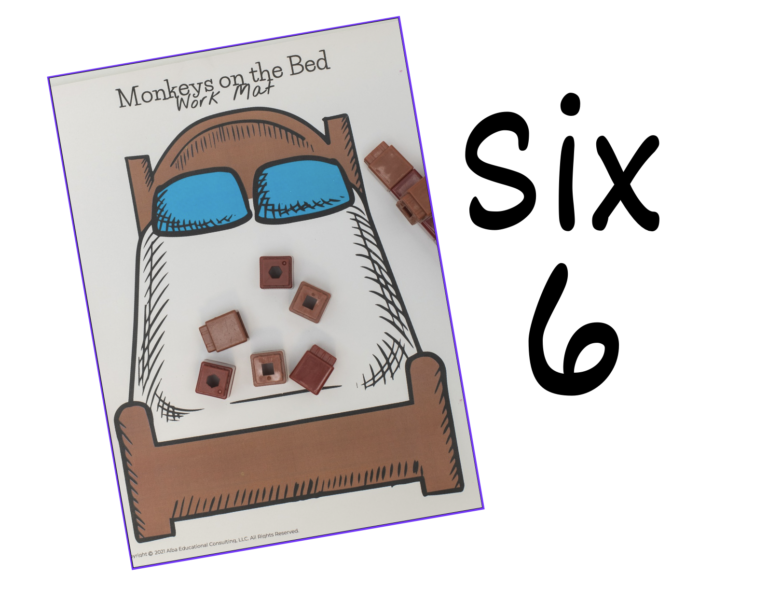
In the image above, students must recognize that the symbol “6” represents a collection of six objects and that it can be used to communicate mathematical thinking.
That is a remarkable amount of cognitive work packed into a single symbol.
Yet numeral writing and numeral formation are often taught as handwriting skills rather than mathematical ones.
The formation poems are helpful. The tracing pages have value. But if we want students to develop strong number sense, we have to think beyond how numerals are written and consider what they represent–because writing a numeral is about much more than making the shape correctly. It is about making meaning.
Two Skills, One Symbol
My son, Max, was diagnosed with dysgraphia in first grade. Years later, an independent evaluation found results consistent with dyscalculia.
Looking back, many of the signs were there long before the evaluation.
As both Max’s mom and a math educator, I noticed numbers seemed to challenge him. Sometimes he could count a collection accurately but struggled to write the corresponding numeral. Other times, he could write a numeral but struggled to connect it to quantity. And oftentimes, numerals were reversed or formed inconsistently.
I now understand that multiple layers were involved. Some challenges were related to the physical act of writing. Others involved processing and understanding numbers.
Those experiences led me to think differently about instruction in numeral writing.
When we ask students to write a numeral, we are asking them to connect three ideas: a spoken word, a quantity, and a written symbol. That connection is foundational to number sense, yet it is often overlooked when numeral writing is treated primarily as a handwriting task.
Max’s experiences reminded me that writing a numeral and understanding numbers are not the same thing. Some students struggle with one, some with the other, and some with both. Recognizing which one a student struggles with helps us provide instruction that meets students where they are. A student who can count eight objects but struggles to write an 8 needs something different from a child who can beautifully write an 8 but doesn’t yet understand what eight represents.
The Mathematics Behind the Numeral
Many early childhood classrooms already teach numeral formation through rhymes and number poems. These tools are helpful because they give children a consistent pathway for forming each numeral.
But learning to write a numeral involves more than learning its formation.
A similar idea applies to early literacy. When children learn to write letters, they aren’t simply learning to reproduce shapes. They are also learning that those written symbols connect to language and sound. In mathematics, written numerals need those meaningful connections, too.
When a child writes 3, we want them to understand that the symbol they write, the word three, and a quantity of three are different ways of representing the same mathematical idea.
So, if we focus only on the poem, a child may learn how to make a 3 without really understanding what that 3 represents. Likewise, a child can trace a 5 over and over and become quite good at forming it without making a stronger connection to five.
That doesn’t mean we stop using the poems or tracing numerals. We just add the mathematics.
For example, after building and counting a collection of four objects, students can write the numeral 4 while reciting the familiar formation poem. Then we can ask, “What does your 4 tell us?”
It’s a small shift in something teachers are already doing, but now the formation practice is connected to meaning.
Beyond Tracing: Helping Children Make Sense of Numerals
So what can we do differently? We don’t need to throw out what teachers are already doing. Instead, we can look for simple ways to connect formation to quantity throughout the day.
This might look like:
- Building sets of objects and labeling them with numerals.
- Counting a finite set of objects before writing the corresponding numeral.
- Matching numerals to collections.
- Discussing what a numeral represents.
- Using consistent formation pathways and verbal cues.
- Air-writing large numerals after counting a collection of objects.
- Tracing large numerals on the carpet, a table, or another textured surface while saying the number name and referring to the quantity it represents.
- Walking numeral pathways taped to the floor while discussing the numeral’s formation and the quantity it represents.


Meaning Made Visible
These multisensory experiences help students internalize both numeral formation and their meaning. Large-motor experiences are especially powerful because they allow children to focus on the formation pathway before the added challenge of controlling a pencil.
The goal is not to abandon numeral poems or formation routines. The goal is to expand them.
The next time a child writes a numeral, look beyond whether they formed it correctly. Ask yourself: Does this child understand the quantity this numeral represents?
We don’t need to stop teaching numeral formation. We just need to make sure the mathematics doesn’t get lost in the process.
Because a numeral is more than a shape on a page. It is a way for a child to make mathematical thinking visible.
FAQs
What about learning to write two-digit numbers and beyond?
The same principle applies. As numbers become larger, students need to connect written numerals to the quantities and place values they represent. For example, when writing 72, students might build 72 with objects, ten frames, or base-ten materials and discuss how the 7 represents seven tens, or 70, while the 2 represents two ones. The goal is for students to see 72 not simply as a 7 followed by a 2, but as a representation of a quantity.
What if a student understands the quantity but struggles to write the numeral?
That distinction is important. A student may have strong number sense but still struggle with the motor or visual-spatial demands of numeral writing. Give the student other ways to demonstrate understanding, such as selecting a numeral card, matching a numeral to a collection, building the quantity, or explaining their thinking, while continuing to support numeral formation separately.
What if a student can write numerals correctly but does not consistently connect them to quantities?
Correct formation does not necessarily mean a student understands the number. Provide frequent opportunities for the student to count or build quantities and then label those quantities with numerals. Asking simple questions such as, “What does this 6 tell us?” can shift the focus from producing the symbol to understanding its meaning.
Blog written by Shannon Alba, M.Ed.
Co-author of Progressions by Alba Math, a K–2 foundational mathematics curriculum, Shannon Alba is a mathematics educator and curriculum developer with experience in classroom teaching, instructional coaching, professional learning, and curriculum design. Her work focuses on helping educators build strong mathematical foundations through developmentally appropriate, meaningful learning experiences.