How to Build Strong Kindergarten Math Foundations
Kindergarten math is as simple as 1-2-3. That’s what many people think. In reality, kindergarten math includes deep, complex concepts that require careful attention. While geometry, measurement, data analysis, addition, and subtraction matter, numeracy is at the heart of kindergarten mathematics. So, this blog focuses on a clear learning progression and practical ways teachers can use everyday classroom experiences to understand better and support student thinking.
Early Number Sense is More Than Counting
Speaking of 1-2-3, number sense and early numeracy foundations are so much more than rote counting. Students need opportunities to practice one-to-one correspondence and count collections of objects. Without these experiences, rote counting becomes an abstract activity with little meaning for our kindergarteners.
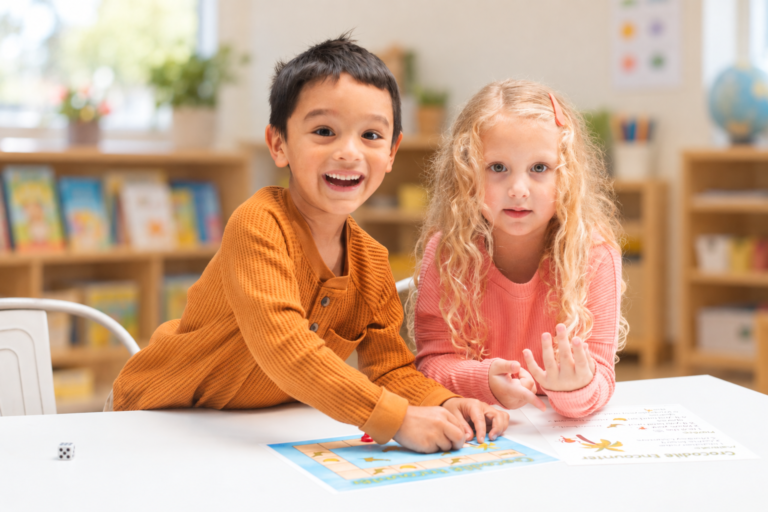
Students practice early number concepts while playing Crocodile Encounter. [Download this free game.]
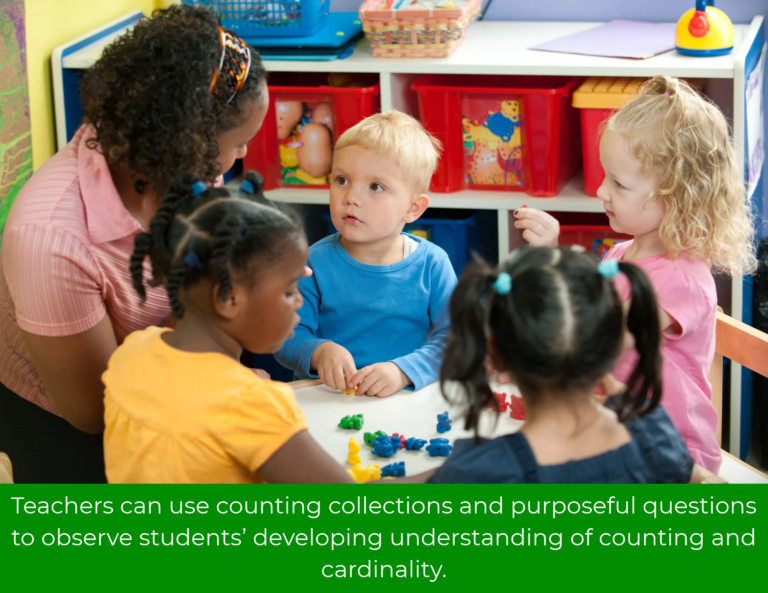
Teachers need to observe students playing board games and counting objects. They need to ask questions such as, “How many?” after students count a collection. If a student has to recount the entire collection to answer, they are still developing an understanding of cardinality.
But don’t stop there. Add one or two more objects to the collection and ask, “How many are there now?” Does the student immediately know the quantity has increased? Do they count on from the number they already know, or do they start over at one and recount the entire collection? This short video shows what this thinking can look like in action.
These simple observations tell us much more than whether a student can count. They give us a glimpse into how that student is thinking about number. Likewise, when a student struggles to move a game pawn the correct number of spaces on a game board, the difficulty may not be with the game at all. The student may still be developing one-to-one correspondence. Early number concepts do not develop in isolation. One understanding supports the next. That is why it helps to think about early numeracy as a learning progression.
What is a Learning Progression?
A learning progression helps us see how mathematical understanding develops over time. It is not simply a pacing guide or a checklist of skills. It helps teachers see how mathematical ideas connect, what students are developing toward, and what understandings support the learning that comes next.
Our Kindergarten Number Sense Learning Progression is grounded in the Texas Essential Knowledge and Skills (TEKS) and the Texas Pre-Kindergarten Guidelines and informed by the work of Dr. Julie Sarama and Dr. Douglas H. Clements. It organizes those expectations in a way that makes the development of early number concepts visible. While students do not always develop mathematical understanding in a perfectly linear way, seeing these connections can help teachers plan for appropriate sequencing of instructional activities.
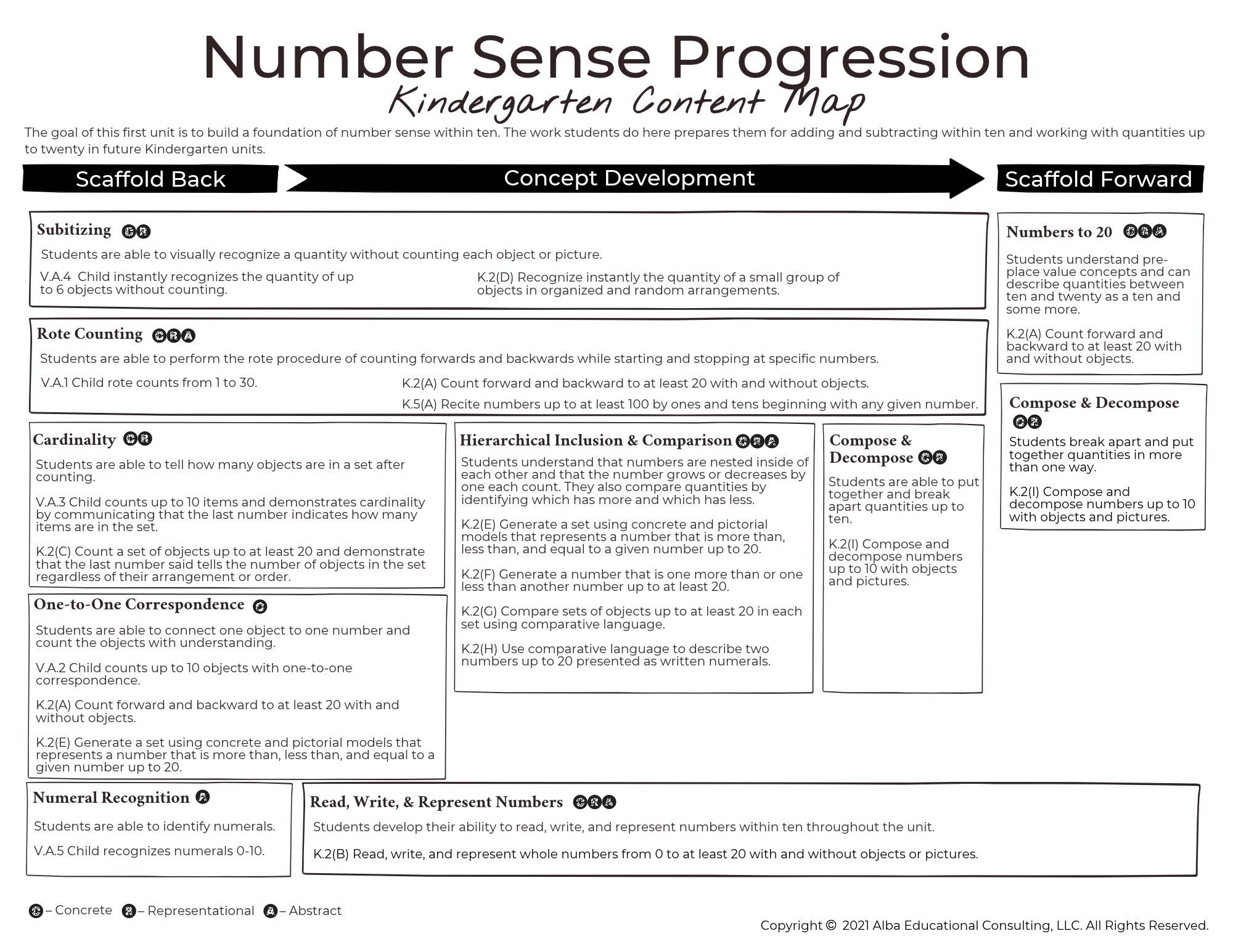
Image download (page 1 only)
PDF Download
How to Read the Learning Progression
Begin by looking generally from left to right, where foundational number concepts support increasingly sophisticated understandings. The progression shows how foundational understandings such as counting and one-to-one correspondence support more complex concepts such as hierarchical inclusion (numbers are nested inside each other) and composing and decomposing numbers.
Start with the arrows across the top. Scaffold Back identifies concepts students may already know or need to strengthen, Concept Development represents the unit’s primary mathematical work, and Scaffold Forward shows what concepts can be extended for students who already have a solid understanding.
Next, look across the progression. Some understandings develop throughout the unit, while others build more directly on one another. For example, cardinality supports students as they begin to understand hierarchical inclusion and compare quantities, which in turn supports composing and decomposing numbers. At the same time, students continue developing skills such as subitizing, rote counting, and connecting quantities to written numerals.
For example, think back to the video of the student counting a collection. If the student accurately counts the objects and tells how many are in the set, we see evidence of one-to-one correspondence and cardinality. But what happens when one more object is added? If the student recounts the entire collection, that gives us additional information. The student’s understanding of cardinality may not yet be secure, or they may still be developing the idea that each successive number represents a quantity that is one more, an important understanding within hierarchical inclusion.
This is where the progression can help us think about what comes next. Rather than simply providing more rote counting practice, we can intentionally select experiences that help students see how quantities change. One of our favorite examples is reading There Was an Old Lady Who Swallowed a Fly by Pam Adams using nested pictures to represent each item the old lady swallows. She doesn’t start over each time and swallow everything again—she swallows one more thing! As the story progresses, students can visualize the growing collection, discuss what changed, and begin to see how each new item swallowed makes the collection one more, supporting their ability to count on rather than recount the entire collection.
This is why the goal is not to place a student in a box on the progression. What we observe gives us clues about a student’s developing understanding. The progression helps us interpret those clues and intentionally choose experiences, questions, and representations that can move their thinking forward.
Concrete, Representational, and Abstract
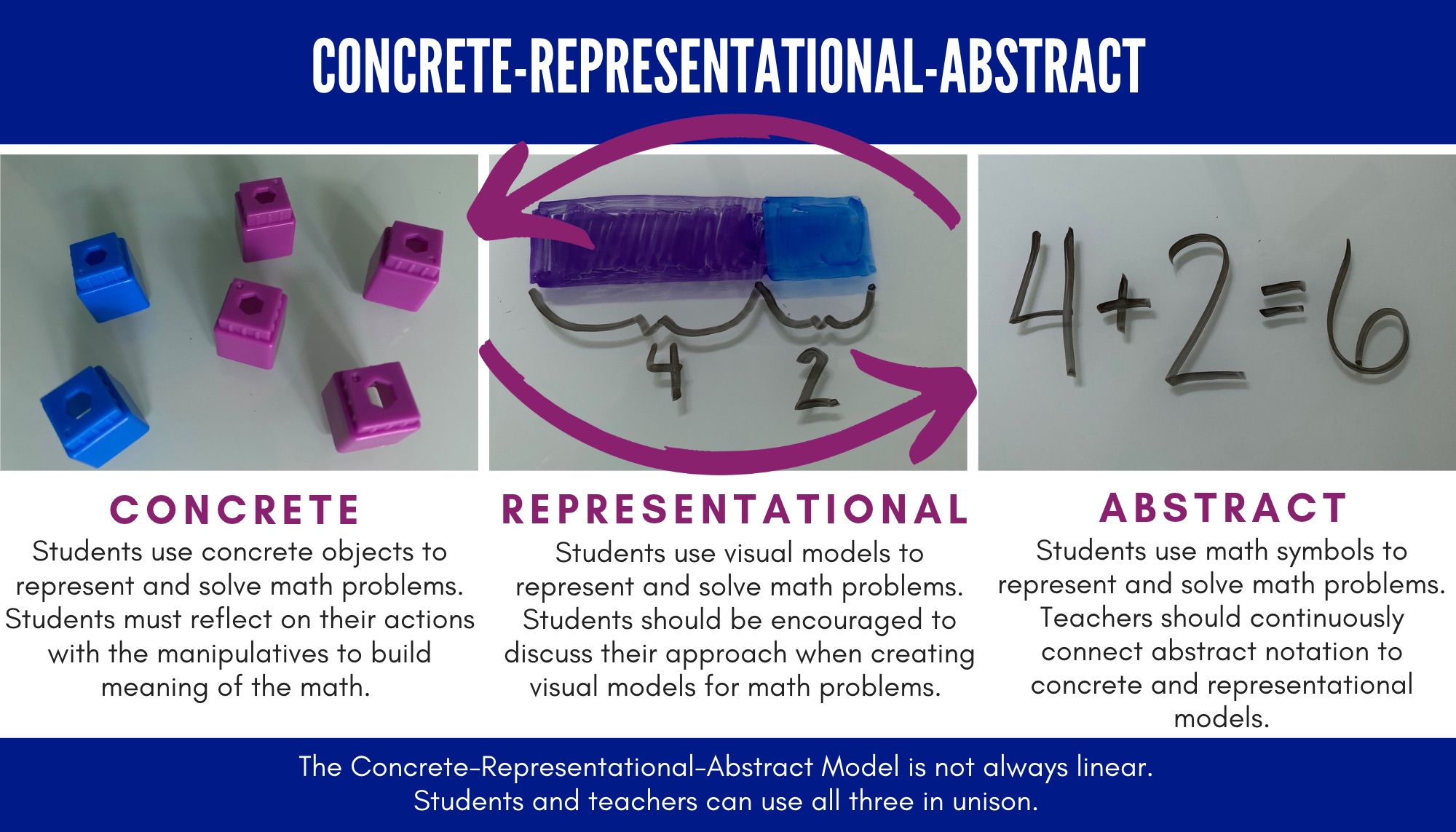
Throughout the progression, you’ll notice the letters C, R, and A, which represent the Concrete-Representational-Abstract (CRA) model. Some may say the Concrete-Pictorial-Abstract model. Students build understanding through experiences with concrete objects, connect those experiences to pictures and other representations, and eventually make connections to abstract symbols and numbers. These stages are not meant to be a one-way path. Students may move between concrete, representational, and abstract experiences as they develop and deepen their mathematical understanding.
Written numerals should also be embedded throughout the unit. As students work with quantities, teachers can initially model the written numeral, helping students connect the quantity they see and count to its symbolic representation. As students develop, they take on more of the writing themselves, strengthening the connection between quantity, number names, and written numerals. For more information about writing numerals, read our blog titled Writing Numerals: The Missing Link Between Handwriting and Number Sense.
Put the Progression Into Practice
I invite you to download the Kindergarten Number Sense Learning Progression and use it as a reflection or planning tool. Consider your instruction, your resources, and, most importantly, your students. How might the progression support you as you plan instruction, select or refine activities, and respond to the individual mathematical thinking of each student?
Download the Kindergarten Number Sense Learning Progression (PDF)
FAQs
You mentioned playing games in the article. Is this an appropriate way to help students develop number sense?
Absolutely! In fact, we encourage incorporating games into prekindergarten and kindergarten math instruction. Games such as Candy Land, Chutes and Ladders, and Pop the Pig can provide meaningful opportunities for students to practice early number concepts such as one-to-one correspondence, counting, subitizing, and cardinality.
Just as importantly, games allow teachers to observe students’ mathematical thinking in action. Watch how students count the spaces or the pips on the number cube, move game pieces, recognize quantities, and respond to questions such as, “How many?” These observations can provide valuable insight into what students understand and what they may need next.
Want to try one? Download Crocodile Encounter, the game pictured earlier in this blog, and use it with your students.
Why did we create a number sense learning progression?
When we developed Progressions by Alba Math, we did not begin by asking, “Which kindergarten standards do we need to teach?” We began by asking a different question: How does a child’s understanding of number actually develop?
That thinking led to the Number Sense Learning Progression that helps organize our approach to early numeracy.
What are some additional resources for learning more about early number sense?
- Learning and Teaching with Learning Trajectories (Clements & Sarama) — Dr. Douglas Clements and Dr. Julie Sarama’s research-based learning trajectories explore how children’s mathematical thinking develops from birth through age eight. Their framework connects mathematical goals, developmental progressions, and instructional activities.
- Erikson Institute Early Math Collaborative — The Early Math Collaborative offers an extensive collection of free classroom videos, activities, articles, and other resources that connect early childhood development with meaningful mathematics instruction. Their Idea Library is especially useful for seeing early mathematical thinking in action.
- Teaching Math to Young Children — What Works Clearinghouse — This practice guide from the Institute of Education Sciences provides research-based recommendations for preschool, prekindergarten, and kindergarten mathematics, including teaching number and operations through a developmental progression.
- Graham Fletcher’s Progression of Early Number and Counting — This video provides an accessible look at the development of early number and counting concepts. It uses manipulatives to make the progression of student understanding visible.
Blog written by Shannon Alba, M.Ed.
Co-author of Progressions by Alba Math, a K–2 foundational mathematics curriculum, Shannon Alba is a mathematics educator and curriculum developer with experience in classroom teaching, instructional coaching, professional learning, and curriculum design. Her work focuses on helping educators build strong mathematical foundations through developmentally appropriate, meaningful learning experiences.